How I Think About Growth
Before I start firing off campaigns for any product, I get clear on the framework first. Heres the system I use to decide what to do, where to do it, and whether its working.
How I Think About Growth
Before I start firing off campaigns for any product, I get clear on the framework first. Here's how I see it.
The eight GTM functions
Everything you can do to get users falls into eight buckets. The first four are things you do yourself:
- Warm outreach — people you already know
- Cold outreach — people you don't know
- Free content — posting, publishing, organic
- Paid ads — buying attention
The latter four are things other people do for you — but there are systems you set up to make them happen:
- Affiliates / influencers
- Product launches and directories
- Referrals within the product
- PR and earned media
Within each of these functions, there are channels. Warm outreach can be across various channels. Cold outreach, the same. Free content, the same. Paid ads, the same.
Choosing which functions to use
It's important that you decide which go-to-market functions you're going to utilize strategically, given where your ICP sits and where your business is at in a given moment.
Not all eight functions are relevant at every stage. If you're super early stage, for example, SEO and AEO is the go-to-market function that is invaluable. The right functions depend on two things: where your ICP actually spends their time, and what stage your business is at right now.
The object model: functions, channels, campaigns, and actions
Here's how I think about the actual structure.
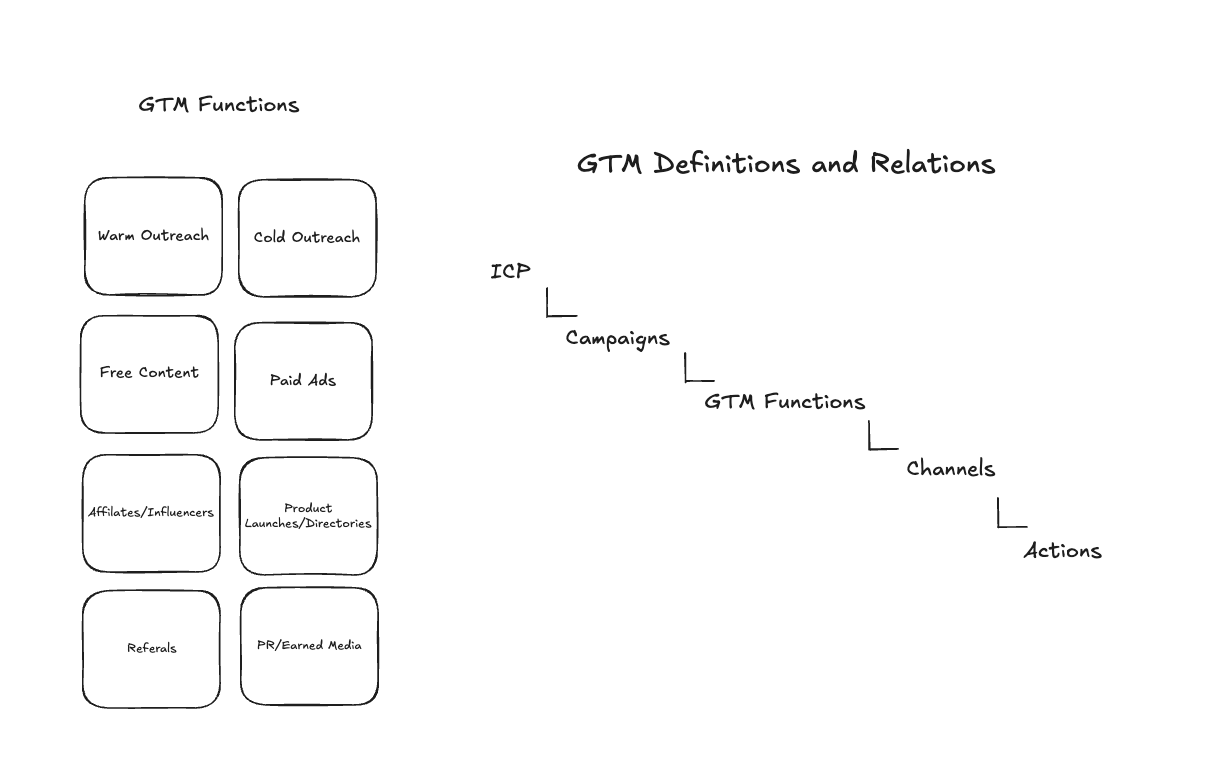
ICP sits at the top. Everything flows down from who you're going after. An ICP has a one-to-many relationship with campaigns — you can have multiple campaigns targeting the same persona, and you'll need separate campaigns for different ICPs.
Campaigns live underneath the ICP. A campaign is a named, trackable effort aimed at a specific persona. Each campaign activates one or more GTM functions — it could lean on just cold outreach, or it could combine free content with paid ads and affiliates simultaneously.
GTM Functions are the strategic layer within a campaign. Each function has channels underneath it — the specific platforms or mediums where you execute.
Channels belong to a GTM function. Cold outreach might run across LinkedIn, email, and Twitter. Free content might run across a blog, YouTube, and a newsletter.
Actions are the atomic unit at the bottom. An action belongs to one channel. It's the actual thing you do — the post you publish, the email you send, the ad you run.
Tracking success
The whole KPI is signups. Every campaign traces back to that one number.
Here's how I track it:
- Given a cost for a campaign — in the form of hours and money invested — over a given time horizon, I hypothesize how many signups it would take to call it a success.
- Set up attribution tracking with UTM links so we can measure post-hoc.
- Track direct signups post-hoc.
Because everyone has to come through the website to download, there's a single conversion point. Every campaign gets a UTM link, PostHog captures source on every signup, and you always know which function and campaign drove it. The website becomes the attribution hub by default.
The credit window ends when the campaign ends. And the decision trigger — whether to kill a campaign or double down — gets defined upfront, before launch.
How this plays out in practice
Growth is ultimately about deciding, at any given time, which functions to activate and which channels within those functions to go after. A campaign is just a named, trackable bundle of actions across those channels, aimed at a specific ICP.
At any given moment you can answer: what are we doing, where are we doing it, and is it working?
That's the whole system. Everything else is just execution.